About Me
Born in Giurgiu and educated in Bucharest, despite having a technical education, I grew up in an environment permanently influenced by the beauty of Mrs. Eugenia Jelescu's painting classes and the atmosphere of the painting circle in the attic of the high school on the corner of Cișmigiu. The superb creations of pre-war artists seen in my friends' homes and my own, the works in museums, the architecture of the buildings I passed by, and the doors and windows in Cotroceni executed with perfect attention to detail, marked me one by one, without me realizing it at the time.
After a long period of industrial activity, with all the routine it implies, because I constantly felt the desire to be creative and to live in an environment more colorful than the everyday gray and beige, I felt the need to detach myself from everything that means mass-produced items and move closer to the area where aesthetics is the main result of my work. This change occurred at the moment I wanted my first stained glass windows for myself, when I discovered that through stained glass I could fulfill both my desire to participate in beautifying daily life, my own and that of others, and use the technical experience accumulated over time at the same time.
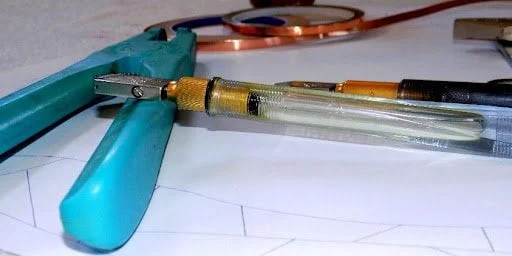 After studying different methods of obtaining decorative glass for doors and windows, I came to the conclusion that the TIFFANY method is the one that suits me best. This is because mass-colored glass, often obtained through semi-industrial processes, gives you the sensation when working with it that it is alive, changing its brilliance every time light hits it from a different angle. Light, that factor which influences our quality of life so much, is what determines an eternal change in the chromaticity of the final work so that a stained glass window, although the same for a lifetime, is different in every moment.
When, constrained by imposed themes and, in many cases, limited by price, I sought the possibility of expressing myself freely, I discovered that by associating glass pieces with mirror pieces, I could achieve results that reflect my desires; I became definitively addicted to this profession. My mirrors, though directly influenced by my periodically changing moods, all express a nostalgia for the times when Calea Victoriei was animated by ladies in elegant dresses and lace umbrellas, accompanied by gentlemen with top hats and cravats.
Through their development and adaptation to the contemporary style of composition, Glass Nouveau mirrors aim to reawaken a taste for beauty and to bring the subject of the survival and perpetuation of craftsmanship back to the forefront. Because the beauty of the small defects inherent in manual work, embedded in the whole of an object that is both useful and pleasant at the same time, can never be matched by the cold perfection of an industrially obtained object. They are pieces of furniture and, at the same time, with your permission, objects of art.
Glass Nouveau mirrors, by developing and adapting the mode of composition to the contemporary, aims to reawaken the taste for beauty, to bring back the subject of survival and perpetuation of crafts. Because the beauty of the small flaws inherent in handwork, incorporated into the whole of an object that is both useful and pleasing at the same time, can never be matched by the cold perfection of an industrially produced object. They are at once pieces of furniture, and at the same time, with your will, objects of art.
 English
  Romanian
  German